Exteriors & Envelope
House wrapand flashingthe layer nobody sees.
Cladding sheds most of the water. This is what catches the rest and sends it back out, and it fails at junctions rather than in the middle.
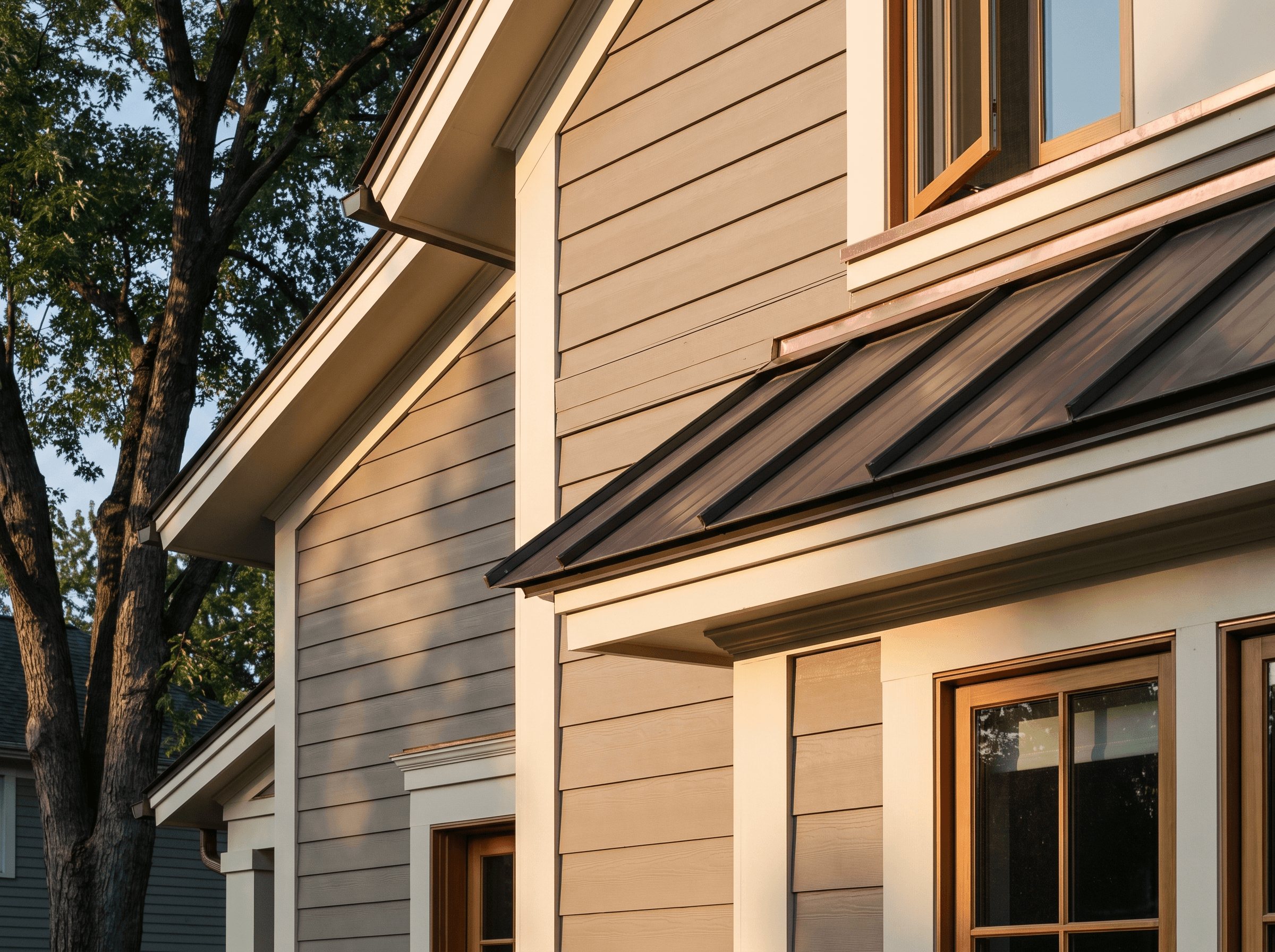
In detail
House wrap & flashing
A water-resistive barrier is not a waterproof membrane and is not meant to be. It is a drainage surface: water that gets past the cladding lands on it, runs down it and exits at the bottom. That only happens if every sheet laps over the one below it in shingle order, if the seams are taped, and if every penetration — every hose bib, light, vent, bracket and conduit — is sealed to it rather than merely poked through it.
The openings are where it matters most, because a window or a door interrupts the barrier completely. The sequence is specific and it is not negotiable: a sloped sill pan first, the unit, then jamb flashing lapping the pan, then head flashing lapping the jambs, then the barrier above lapping the head flashing. Every failure we have been called in to diagnose on a reasonably new house has been a sequencing failure at one of those laps, not a product failure. Getting it right costs almost nothing extra at the time and is effectively impossible to correct later.
What this covers
- Barrier lapped in shingle order, with every horizontal seam taped
- Sloped sill pans with end dams under every opening
- Jamb and head flashing lapped in the correct sequence
- Every penetration sealed to the barrier rather than through it
- Part of
- Exteriors & Envelope
- Typical timeline
- 2–8 weeks
- Where
- All 21 New Jersey counties
Questions
Asked most abouthouse wrap & flashing
Is house wrap really necessary under siding?
Yes. Every cladding admits some water — at a butt joint, behind a nail, under wind-driven rain at a corner — and without a drainage surface behind it, that water reaches the sheathing. The wrap is cheap, it is quick, and it is the difference between a wall that dries and a wall that rots quietly.
Can flashing be fixed without removing the siding?
Rarely, and that is the honest problem with it. Flashing sits behind the cladding by definition, so correcting a sequencing error usually means opening the wall at that elevation. It is why we treat a re-side as the one opportunity in decades to put the whole assembly right rather than only replacing what shows.
The rest of the scope
Everything else inexteriors & envelope

Start your project
Ready to build or remodel your home?
Let's create a home that fits how you actually live — and holds up for the next twenty years.